About LASIK

Understanding the Eye

Dr. Travers treats nearsighted, farsighted and astigmatism conditions

In order to understand how a Lasik procedure is performed, it’s important to understand what causes irregularities in your vision.

eye-normal

The Normal Eye

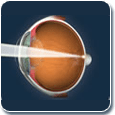
The normal eye experiences clarity of vision because light rays pass through the cornea, pupil and lens, and focus directly on the retina. The image of the target object is formed in the proper location of the retina for sharp, clear and focused vision.

Myopia

Myopia or nearsightedness, is a condition when the eye is horizontally elongated and/or the cornea is overly curved. This causes light rays to focus in front of the retina resulting in blurry distance vision. Treatment for Myopia involves slightly flattening the cornea. This is accomplished by focusing the laser’s beam to remove tissue from the center of the cornea.

Hyperopia

Hyperopia or farsightedness, is a condition when the eye is too short and/or the cornea is flatter than normal. This causes light rays to focus beyond the retina creating blurry close-up vision. Treatment for Hyperopia is an adjustment that involves slightly steepening the cornea. This is done by focusing the laser on removing tissue from the periphery of the cornea. The final pattern resembles the shape of a donut.

Astigmatism

Astigmatism occurs when a cornea is shaped more like a football. This means the cornea is curved more in one direction than the other. This causes light to focus on more than one point, creating distortions and ghosted or multiple-image vision. Treatment for Astigmatism involves reshaping the cornea to be rounder and more balanced, or even. The laser’s beam pattern removes more tissue from one direction than the other rendering the cornea with the desired shape.

Get in Touch

QUESTIONS ABOUT LASIK?

Contact Travers Lasik Today and One of Our Representatives Will Respond Shortly!

How the Lasik
Procedure Works

LASIK has become the most popular and successful vision correction procedure worldwide. LASIK (Laser Assisted In Situ Keratomileusis) surgery permanently changes the shape of the cornea, so patients can be freed from the constraints of glasses and contacts.

LASIK is a fast procedure performed while you are awake, lying flat. At Travers Lasik Vision Care, this procedure begins by putting special anesthetic drops into your eyes. You will also be offered a mild sedative. Lasik is performed in three steps:

procedure
01
step1
Step 01

Your eye will be immobilized so that it cannot move during the procedure. Then a flap is created in the cornea, and is gently lifted up.

02
step2

Step 2

Using a cool-beam excimer laser, the cornea is reshaped for improved vision. The laser is programmed specifically for you based on your pre-surgery vision evaluation.

03
step3

Step 3

The flap is laid back into place, and immediately begins healing. The entire procedure can be completed in a matter of minutes.

Right after your surgery, you will rest for a short period. You will need someone to drive you home, where you should rest again for a few hours, or for as long as Dr. Travers recommends. To help your corneal flap remain in position and heal properly, you should avoid rubbing your eyes. You should also avoid strenuous exercise. You’ll be instructed to moisturize your eyes with preservative-free tears, follow directions for prescription eye drops, and return to the clinic for scheduled follow-up exams. Most patients will experience a rapid visual recovery and return to normal activity in a matter of day

We understand and value the importance of your decision to have Lasik Surgery. Please click the buttons to learn more about our most Frequently asked Questions or to Contact Our Team.

Dr. Travers Has Completed Over 70,000 Lasik Procedures!

Get started by scheduling your complimentary consultation